
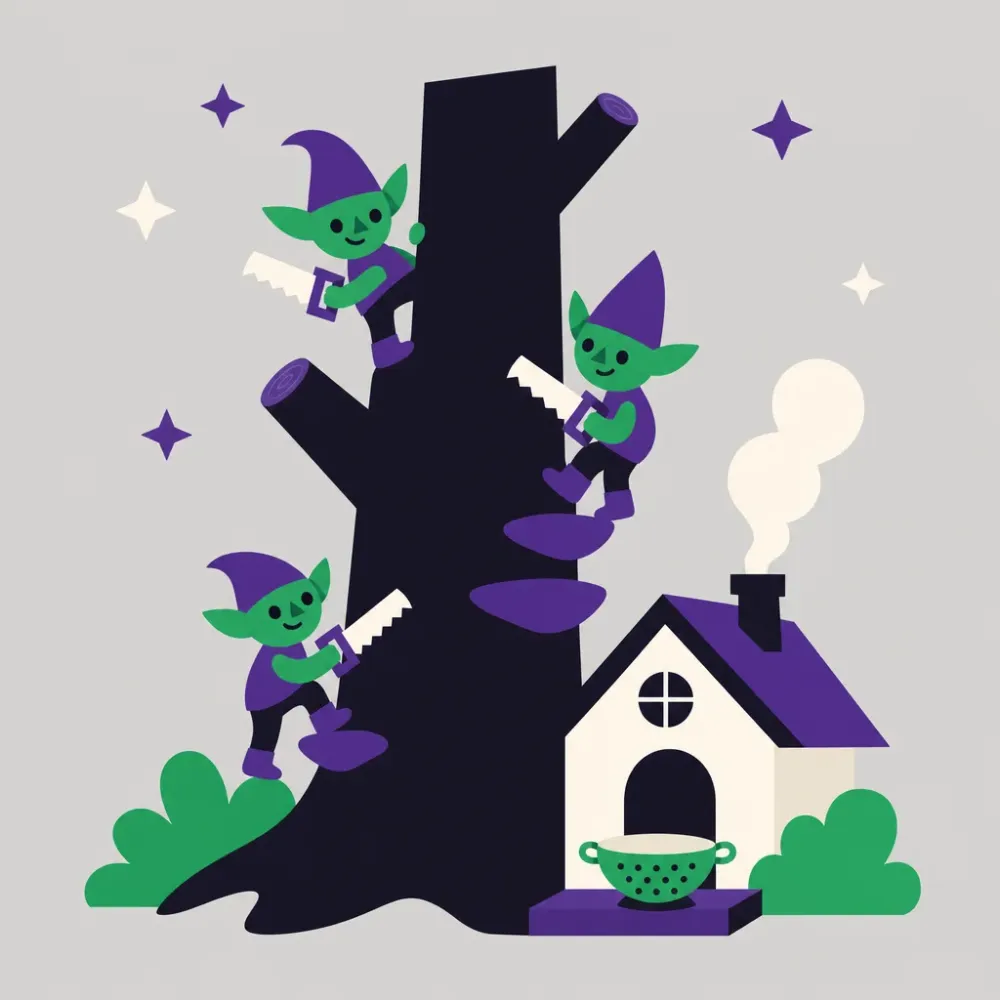
TL;DR In Greek folklore, the kallikantzaroi are goblins who spend the year underground sawing at the tree that holds up the earth. During the twelve days of Christmas they come up to cause mischief, until the blessing of the waters at Epiphany sends them packing.
The myth in 60 seconds
- Kallikantzaroi (say kah-lee-KAHN-tzah-ree) are mischievous goblins of Greek folklore who live deep underground.
- All year long they saw at the great tree that holds up the earth, and by December they have almost cut through it.
- Just before they finish, Christmas arrives and they scramble up to the surface for the twelve days until Epiphany, sneaking down chimneys, spoiling food and playing tricks.
- Families kept them out with a fire burning in the hearth and, in many retellings, with a colander left on the doorstep, because a kallikantzaros has to stop and count every hole.
- On January 6, when the waters are blessed at Epiphany, they flee back underground to find the tree has healed, and the sawing starts all over again.
That’s the whole legend. Switch the Q&A back on for the goblin details.
What do they look like?
That depends entirely on which village you ask. Accounts describe them as tiny or huge, hairy or skinny, sometimes with animal legs or glowing red eyes. Folklore has no style guide, which is part of the fun.
Why the twelve days of Christmas?
The period from Christmas Day to Epiphany on January 6 is called the Dodekaimero, the “twelve days”, in Greek. In folk belief it was an in-between time when the usual order of the world loosened a little, so it made sense that goblins would take the chance to visit.
What is the deal with the colander?
The story goes that a kallikantzaros cannot resist counting the holes, but cannot count past two, because three is a holy number and saying it is impossible for him. So he starts again, and again, until the rooster crows at dawn and he has to run. Peak goblin efficiency.
Is this an ancient Greek myth?
No, and that matters. Unlike Prometheus or Medusa, the kallikantzaroi do not come from ancient poems. They belong to later Greek folk tradition, passed on by word of mouth, and details change from region to region. Scholars have suggested various origins, but none is certain.
Do Greek Canadians know about them?
Many do. Greek Orthodox parishes in Canada, including the big communities in Toronto and Montreal, mark Theophany, or Epiphany, on January 6 with the blessing of the waters, the very ceremony that is said to send the goblins home. And frankly, after a few days of a Canadian January, any sensible goblin would be glad to go back underground where it is warmer.
Are they actually dangerous?
Mostly they are pests rather than villains. In most tales they knock things over, gobble the holiday food, tangle the wool and frighten anyone who stays out too late at night. Annoying houseguests, basically, who come down the chimney instead of using the door.
How else did people keep them away?
Keeping the hearth fire going for all twelve days was the classic defence, since they like to come down the chimney. In some places people tossed something smelly onto the fire to put them off. After Epiphany, the priest traditionally visits homes to sprinkle holy water with a sprig of basil, a final reminder that the goblins’ time is up.